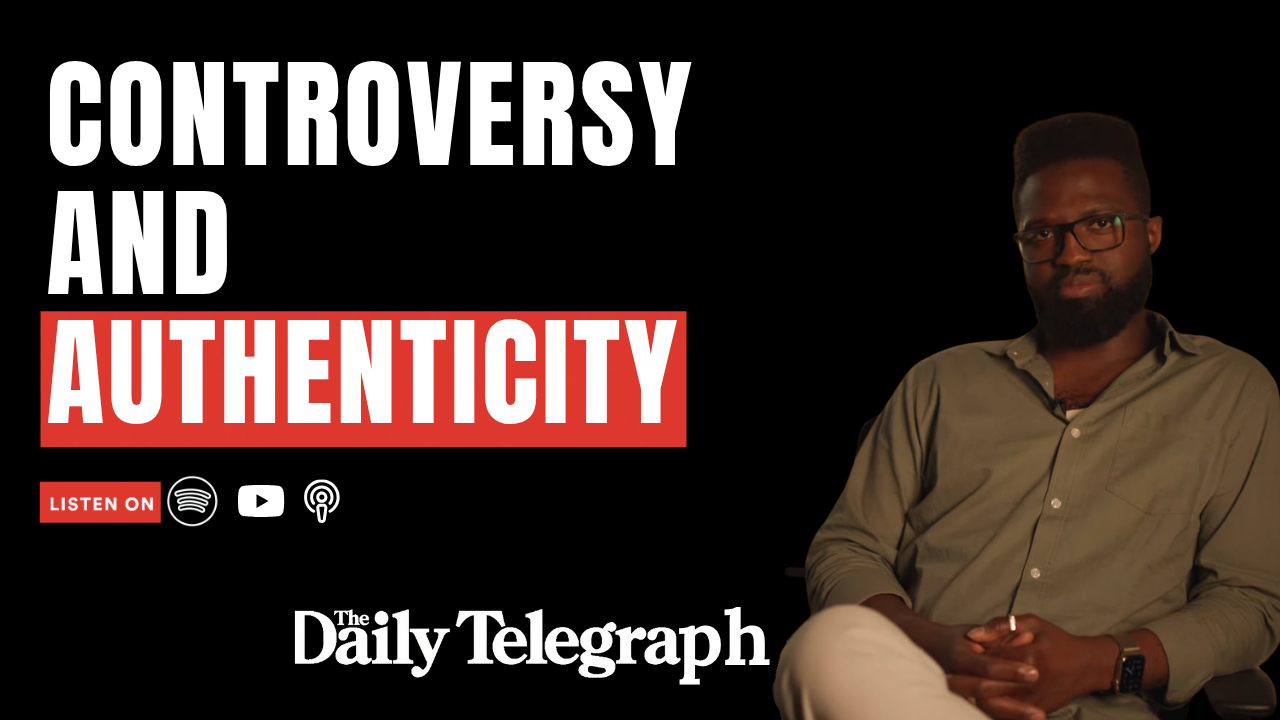
Authenticity Under Fire: The Viral Controversy That Sparked Emeka Unscripted - E1
In the debut episode of Emeka Unscripted, Emeka Edwin-Nweze opens with a raw and fearless conversation about authenticity, controversy, and cancel culture in today’s hyper-reactive world. When a light-hearted Donald Trump deep-fake video turned into a viral storm, Emeka suddenly found himself at the centre of a national debate about freedom of speech, intent vs impact, and what it means to lead with honesty in the age of outrage.
In this unfiltered conversation, Emeka reflects on:
The LinkedIn post that triggered online backlash and media coverage
Why authenticity matters more than approval, even when it costs you
The hypocrisy of cancel culture and the mob mentality of modern media
His candid interview with journalist Julie Cross and what it taught him about leadership
Why context, humility, and self-reflection are essential for rebuilding public trust
How true accountability isn’t about silence, it’s about conversation and growth This episode isn’t about controversy for controversy’s sake, it’s about how we rebuild truth and compassion in a world addicted to outrage.
Watch. Reflect. Engage. Subscribe for more real, thought-provoking episodes that explore politics, culture, and humanity with courage and conscience.
Transcript
My name is Emeka.
I am a passionate advocate for humanity. I love people. I love looking after people. I love caring for humans, as another human myself.
There are so many people in our community in society that are vulnerable and can't look after themselves. They need support, love, and care, and so I am passionately wanting to ensure those people - whoever they might be and wherever they might be - they will get the kind of love and care that I would want to get someday.
That's why I do the things I do like Neta Care. That's why I'm an entrepreneur. That's why I come up with innovative, new, interesting ideas to change what we already do and what we've done for so long that has not yielded any different results to something that might yield new results.
I love our world and I love that I get to be a part of humanity and I want to be able to see change where change is needed. I want to be able to change our community and our society for good and do whatever I can to impact that.
I know that I influence in the way I speak, in the way I interact with my community and with my environment. I've always been able to influence people that way. And so I lead with a level of humility knowing that perhaps someday with the courage and bravery and humility that I carry, I can make a difference to our world.
This is why I decided to start and launch a podcast that will be more than a podcast. It will be a platform where I will talk about not just who I am, but some of the important visions and missions of our world, some of the important issues that matter, some of the places where significant changes need to happen. Whether it be in business or in politics. Whether it be in the way government do what they do. Whether it will be in the way social justice is applied. Whether it will be in the way that humanity interacts with each other. Well, I believe I've been given a mission to bring change to these various areas.
And so as I launch this platform, the aim for me is that it will not just be us talking about these important issues, but it will be about being able to make a real change to society, whether that be in politics, or in business. I hope that the conversations that will be had will start as a conversation, but will quickly evolve into impact - real change where it needs to occur.
There are many things I am passionate about. So over the next little while, we will get to talk about those and I'll be inviting guests to be a part of the conversation. I would love for you to join me because maybe a conversation can start off the fire that is needed to kindle a change.
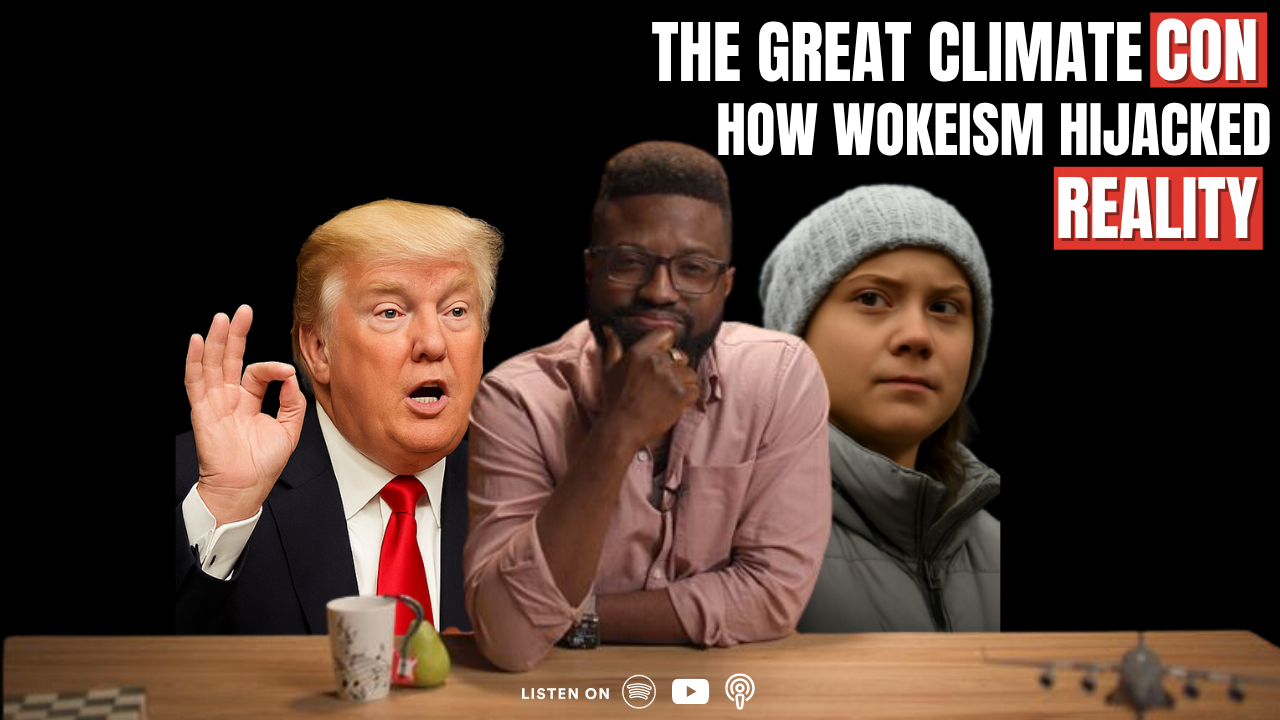
I didn't plan to launch my first podcast so soon, but something quite interesting happened over the previous week. You see, I like a bit of controversy, and I really enjoy speaking into things that are challenging to humanity. And so I made a post on my LinkedIn which was a Donald Trump deep fake video. It was quite interesting, and something particularly in there that he said (which wasn't said by Donald Trump as it was AI) was that conspiracy theories are just spoiler alerts. Now I personally find this quite funny and entertaining because I'm quite a bit of a conspiracy theorist myself.
Well, I posted the video, because I thought it was funny and I thought I should share that hilarity with others. However, something was picked out of the video that I didn't even particularly notice myself during the time of watching the video, and that was “Donald Trump” said something along the lines of, "The idiots are trying to turn your children into gay, retards, or both." Something along the lines of that. I didn't particularly pick this up, and I only picked it up after I went back and listened to it. So somebody listened to it (though many people watched the video), but a person named Andrew Jackson commented on my video and he said something along the lines of, "So, do you agree with the statement that gay people are retarded?"
I was in a very busy day, and I quickly commented and said, "Well, I don't know. I'm not a medical professional, but from my point of view, maybe it is linked to mental illness because it seems unnatural to me."
Now, it was a quick comment, a very quick passing by comment. I didn't think much of it, but very quickly that comment was screenshotted in isolation from the rest of the video. That was posted by a lady called Melissa. And then a storm began.
I quite like to be authentic as a human. I am true to who I am. I don't change whether you meet me today, tomorrow, the next day. I try to remain the same because I felt in my life and in my existence that consistency pays and it matters. So you see the comment was screenshotted and very quickly it became the talk of the internet and then the “mob” and the “mafia” and everyone in between all started saying something. It quickly snowballed into other people commenting and reposting and having their own versions of it. You see people think that I was standing on my comments and refusing to acknowledge that I was wrong in making the statement that I made.
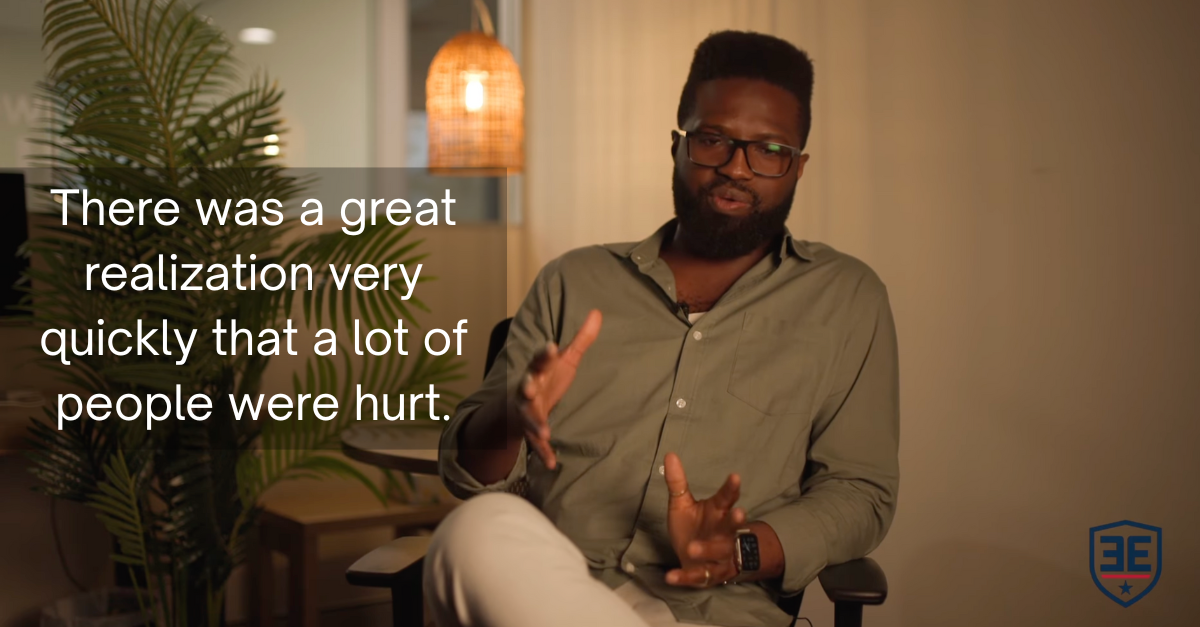
Admittedly, let's just say now: my chosen platform was not the best. And also, there was a great realization very quickly, that a lot of people were hurt. And the kind of person I am is not the kind of person that likes to see humanity hurt. I can't stand for all the things I say I stand for if I am okay with people being hurt because nobody should be hurt in the process of somebody wanting to voice their opinion. But I understand it, and so I apologized very quickly.
Before that though, I did post something and I said the internet mob is coming for me and I say let them and I said this because yeah they were coming for me and they were commenting all sorts of things - all sorts of horrific things. There was so much hypocrisy that I saw. You know they will say that they think nobody should patronize my business because it was filled with homophobes. I wasn't a homophobe. Imagine I did that to somebody who didn't believe what I believe. You see, what I was doubling down on wasn't the fact that I'd made this comment that was not okay by many people. It was the fact that very quickly I could pick out the hypocrisy: I could not say something, but you were allowed to say whatever the heck you wanted to say and that was completely fine.
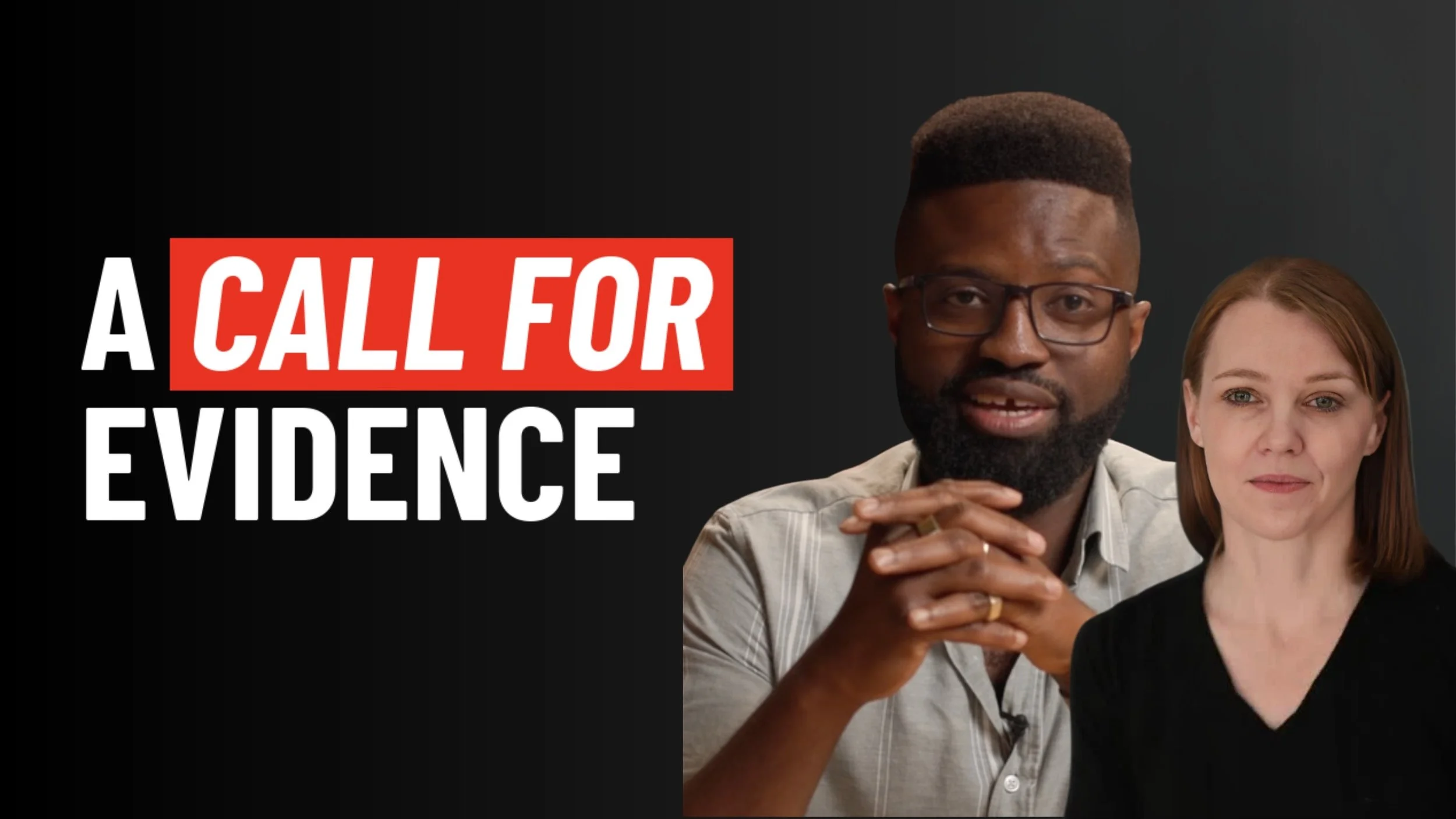
A reporter quickly reached out to me over the following days, and her name was Julie. Julie Cross is a very notable reporter, and she wanted to have a conversation with me about it. At first, I was quite worried and scared about what might she ask me and what might she be able to pull out that I'm not okay with being shared to the world. But again, I can't be the authentic leader that I want to be or say I am if I'm not willing to confront these matters dead in the eye. So over the following day very quickly I sat down and I did the interview with her.
Well what you're about to read is the interview transcript itself between me and her over teams. It was quite brief (lasted for about 35 minutes) where she asked me some very challenging questions. You see, I do believe that Julie Cross was probably sent to me to ask me a bunch of difficult questions. Perhaps in some sort of hope that I might say the wrong thing, but thankfully that didn't occur.
And so, I've released this as my first podcast, even though I actually planned on doing this far before this occurred. I thought it was time to release it, start this channel, and start the introducing who Emeka Edwin-Nweze is to the world, what I stand for and the kind of leader that I am going to be.
So enjoy reading the interview transcript. I think it didn't turn out to be what I anticipated it would be. Certainly, when Julie Cross wrote the article, it wasn't what I anticipated she would write. But I'm grateful nonetheless that she was true to being a good reporter and she recorded accurately and factually what has occurred. So it might be fun for you. You might be entertained by it or you might be challenged by it or you might find that it's necessary for you to engage in dialogue with me. Either way, enjoy.
Julie >> How are you?
Emeka >> I'm well, thanks. How are you?
Julie >> Yeah, not bad. Good. I might just shut this door so that you haven't got any sounds coming from outside.
Emeka >> That's okay. I'm at home as well, so if you get some random noises occurring, that's what it is as well.
Julie >> There you go. Let's get into it. I've got a bit of a deadline. So you've managed to upset a lot of people on LinkedIn. What do you think went wrong?
Emeka >> I've definitely learned quite a number of things over the last little while, 48 hours or so. I think, definitely from my position, what has gone wrong is the choice of words in the platform on which I've obviously placed it - probably were the highlights of the problems, the beginning of the problems. The choice of words around you it. I was asked by Andrew Jackson whether I "likened retardation to homosexuals” - something along the lines of that - and I responded by saying that “I am not a medical professional. I don't really know, but to me it seems unnatural, and so perhaps it's linked to a mental illness.” and I think the choices of words probably could have been better chosen.
Emeka >> Also it was kind of spur of the moment. Andrew does a really good job at poking at me all the time, whenever I post anything. So I always appreciate just poking back at him in whatever way possible. Certainly, I think that was certainly the start of what has gone wrong, because then that was screenshot and posted by a lady called Melissa, who I don't know, but she's posted it and tagged me in it. Then it's kind of escalated from there. I'm sure you've done it yourself, right? You've kind of gone through that and seen the the flow.
Julie >> Yeah. Can you can you understand why people are upset about that being linked? You know, being gay and that being linked with mental illness has upset people. Can you understand that or… ?
Emeka >> Of course I can. Of course I can, and I will say, certainly when I said those words, I definitely… Let me put it this way. I have a lot of people very close to me that have mental illness and things that are going wrong in their life, that they're not quite in control of, or whatever might be the case. And so I can understand why people will. From that perspective, right. On understanding what people dealing with mental health issues and how difficult that can be for them. I can certainly understand why people would feel that way. My intention was definitely… It was in my mind in communicating, that it was like there was no ill-intent of “Oh well - that's a bad thing. Because there is a normalcy to what mental health is in our day. In our age. Because of the swarm of people that suffer through it - very close people in my life, very close proximity, that have a lot of issues there. So not even necessarily. Even if you were to view it as it having a negative connotation, I was not seeing it in the negative light. Because many close people, who are very good people to me, that I really treasure, do struggle with mental health. So I wasn't saying “it's a bad thing.” I was saying “this is what it seems like to me from a non-medical position.” But of course, like I said, I can certainly understand the great irritation that people have around that.
Julie >> Can I ask - so you're saying that you know that you've upset people with mental health issues? Is that what you're saying?
Emeka >> No. No, that's not what I'm saying at all.
Julie >> Right. Okay. So you seem to say that you think you've upset people with mental health issues ‘cause that's what you…
Emeka >> No, no, no. Not at all.
Julie >> You just referred to mental health issues. I thought that you would be apologizing to gay people, not to people with mental health issues.
Emeka >> No. My apologies were for the choice of words that I used that had now caused hurt for people.
Julie >> Yes. So you you think you've caused hurt for people that have mental health issues? That's what you just said just just then. It seemed to suggest.
Emeka >> No. Not quite. Not at all. So if it suggested that - let me rephrase. I said that I recognize that mental health issues are a severe matter for many people and I have close people within my proximity that do go through those struggles. And so I understand why, for anyone who is linked to that community, me likening the path of life that they're on - their preferences in life, their choices, or how they they were born, or what they feel - me likening that to a mental health issue, I can see how that can be very upsetting for them. Because for some people it's not a choice. For some people it's just they believe that it is who they are. And so I can very much understand how that can be upsetting for them when it is linked. So I'm talking about the people that are offended, which isn't, I don't think, anyone with mental health issues was necessarily offended. I haven't really seen any commentary on that. But those offended have been largely the community that I referred to in the conversation. Right.
Julie >> The gay people.
Emeka >> Say again. Sorry.
Julie >> Sorry. So you're saying that you're apologizing to gay people that have been offended.
Emeka >> to anyone who's been offended, not just gay people who have been offended. Yes, absolutely. ‘Cause I think that even people within proximity of family members and friends that are in the community, even if they're not themselves - they were equally offended as well. So yeah, to everyone.
Julie >> So you're apologizing for offending people, but do you still believe that if you're gay, then you must have a mental health issue or a mental illness? That was what was written down at the time.
Emeka >> and I've stated now that I pragmatically quoted with this phrase saying stating that I'm not a medical professional, so of course I can't. And even if I believe that, it's completely irrelevant. I'm not a medical professional. But I don't. That's what I'm saying
Julie >> right. Because you kind of defended what that statement during some of those LinkedIn posts.
Emeka >> in what way, sorry? How?
Julie >> defending the right be able to say that. I think wasn't that right, during some of those posts?
Emeka >> you'll have to give me… there's been quite a lot of posts and commentary so you'll have to give me some specifics so I can contextualize it.
Julie >> you know… cancel culture and how you know people are trying to cancel you because of your beliefs. So do you still feel like you've been canceled or tell me how you feel about being able to say what you believe.
Emeka >> so being able to say what I believe and every person should have a right of freedom of speech. For example, how would you feel if I said to you that because I believe in Jesus as my Lord and Savior, if you don't believe in that I can't have a conversation with you, because I wouldn't find that you've accepted me; You need to accept that in order for me to accept that you've accepted me. Because I think that's the fine linkage that is being made here: that I must accept something that others accept in order for me to be viewed as acceptable by them. I can have a disagreement with you and we can have difference of opinion that is predicated on our core beliefs, that is predicated on how we've grown up where we've grown up, and how we were raised, etc., and that is okay. I should be able to voice that and articulate that without fear of being rained down on by a mob who wants to silence me.
Emeka >> When I talk about the view of being cancelled, the facts remain, right? I posted something and yes, it was taken out of context. It was just the comment screenshot. It was then written up with new ideas that delved into it, linking all sorts of things. And then, within 24 hours, I have had a mountain of people commenting on that, bringing in even newer ideas of what I was saying, which is not what I was saying. It's all been based on one comment. One single comment. You have no idea who who I am, what I've done, what I've achieved, and where I'm going. Yet one comment gets to determine who I am and then it extrapolates from there, and so very much of what was happening even within Melissa's post. And this is factual. You can go back and check it, and I hope they never take it down and because integrity should count. You go back and check it. It very, very quickly became about silencing me, because I shouldn't be saying these things at all. Now, I admit that the choice of words were not ideal and they were a mistake. I shouldn't say that, because fundamentally part of my faith teaches that I should love all people and take care of all people, which is what I do. I mean - I have!
Julie >> Yeah. I think that, following that comment, you immediately were criticized when you made that comment, but you stuck with it. You didn't apologize straight away. So, I guess that exacerbated it and that comment followed on from you posting - it was a fake video of Donald Trump making extreme views about trans and gay people. So, I suppose, that was what angered people in the first place.
Emeka >> Sure. That was the first thing. That was the first video.
Julie >> Yeah. Yes.
Emeka >> I forget the timeline in the right order. So, we got the first video - in that video was the comment from Andrew Jackson, which I responded to, which then preceded Melissa's comments. Now, it needs to be really clear, because I think this is what happens when a whole host of people gets involved and everybody wants to have a say (just like I do). Right? They all get involved and they’re all having their say, but very quickly what you see is that it gets misdirected from what is the original issue. Very quickly, it morphs into something completely different. So yes, the preceding post that I placed up, yes, was not an apology. The reason (and if you read that preceding post, I was very clear on what I said there) because I was coming at the fact that very, very quickly. Yes, my choices of words were not right. And yes, I represent an organization that cares for people, but it's in the actions that matter. I have done more than enough in my time. I'm a person with a disability. I've got a spinal injury that I sustained from my time in the military. Right? So I love what I do, and I care deeply about what I do. So I don't mean to hurt those people in any way. So I was being come at and and effectively being shut down, effectively being cancelled, because that's what the culture does if they disagree with anything you say, rather than having a fair, reasonable, and okay conversation. It's okay to disagree. To have a discord. That's not what was happening. You look at the commentary. I was being put down. I was being called all sorts of names and etc. Imagine if I did that. Imagine if I went online and I found an organization who was run by a gay person and let's just put it in this context. I found an organization who was run by a gay person and then I went and placed on their Google page saying this organization is full of gay people. They are terrible human beings, because I don't believe in anything that they do, think, or say. No one should go and patronize their business, and they're absolutely awful human beings, and they would be condemned to hell. Imagine if I did that. Well, I would never do that because that's not the sort of person I am. But that is exactly what happened out of Melissa's post.
Julie >> Right. Okay. But let's get to how it all started with the video that you put up. Why did you put that video up? I mean that was upsetting to people. It upset people.
Emeka >> I understand that.
Julie >> Why did you think it was a good idea to put it up?
Emeka >> So for one, I'm someone who is entertained by controversy in some capacity. Probably in a large capacity. I'm deeply entertained by controversy. Also, I'm also a person who holds very strong beliefs about things. I hope to someday influence and change our world. And so I'm not going to do that by being a person who's agreeable with everything that the culture of the day says and does. I've got to have beliefs that I affirm to. Now, do I 100% endorse the video for everything that was said in it? Absolutely not. Okay? For the most part, it was kind of funny. There was a lot of things that were said in there that were funny, and most especially the main thing. And there's only one person who actually (maybe there were more, but I only probably only recognized one person because I'm familiar with her and she's worked at Neta Care in the past) who saw the funny of what I was actually putting up. And she asked the question, I think she said, “I don't get this.” There were some other things she said in there, but the one particular thing that was really funny to me about the video was when he said something along the lines of “conspiracy theories are just spoiler alerts.” Now if you know me, there's a lot of conspiracy theories that I have, that have all been proven over time to be absolutely true, so I found that particular statement really funny. To be quite frank with you, I probably didn't even hear the gay/retardation part. Okay. It was a 55 seconds video - if that - maybe 40 seconds. Something along the lines of that. Okay.
Emeka >> So, when he placed that up, I was in the middle of my day. I've been helping my mum move houses. I flew to Tasmania from Brisbane to help my mum move houses. That's what I've been doing for the last two weeks. So I just quickly kind of responded to it without even really thinking, “oh, what did he say that? Oh my god.” And I went back and watched the video. I was like, "Oh, right. No, he definitely did say that." So I get that it upset people and perhaps I should think more significantly in some of the things I do and say. But to answer your question I do like stirring up controversy, and I thought the whole thing about conspiracy theories are just spoiler alerts would stir controversy. That's why I posted it. It's actually quite funny, because it didn't actually take off for quite a long time between when I first posted that video and when all of this has started. It has been quite a significant time between. So that's the answer.
Julie >> Okay so do you think as an NDIS director that it's a responsible thing to do? To post videos like that? How do you think that impacts on your clients, for example? Perhaps clients that are gay? How do you think that has made them feel?
Emeka >> Have you watched the video, Julie?
Julie >> Yeah.
Emeka >> Okay. So the statement that we're referring to here is where he says, “they're trying to make your children gay, retarded, or both.” Now what Andrew Jackson did there was he linked gay and retarded. Okay - that's not what was said. What was said was gay, or, not the same thing. So I never really thought that. And again, it didn't lock into my mind. I've only gotten this now when I went back and watched the video at the time. The time when I watched the video originally, I probably did not contextualize it that he was calling people with the disability that I served either retards or gay people. That's just well and truly out of context, isn't it? Because the facts are the words that were said didn't call them one and the same. So, it's so hard.
Julie?>> Like that’s picking at it. I think that the video was still upsetting for gay people.
Emeka >> because he said they try to make your people gay, retarded, or both. Admittedly, I get it. I hear it now. That's the learning I've done.
Julie >> Yeah. And then in what followed was that comment that you made likening gay people to having a mental illness and then doubling down on that in some of the following comments.
Emeka >> So, if you you might give me an example of one of the times I've doubled down, so I can contextualize that as well, please.
Julie >> Well, I'd have to go back. But you doubled down and you're right to be able to say what you think. Do you not agree?
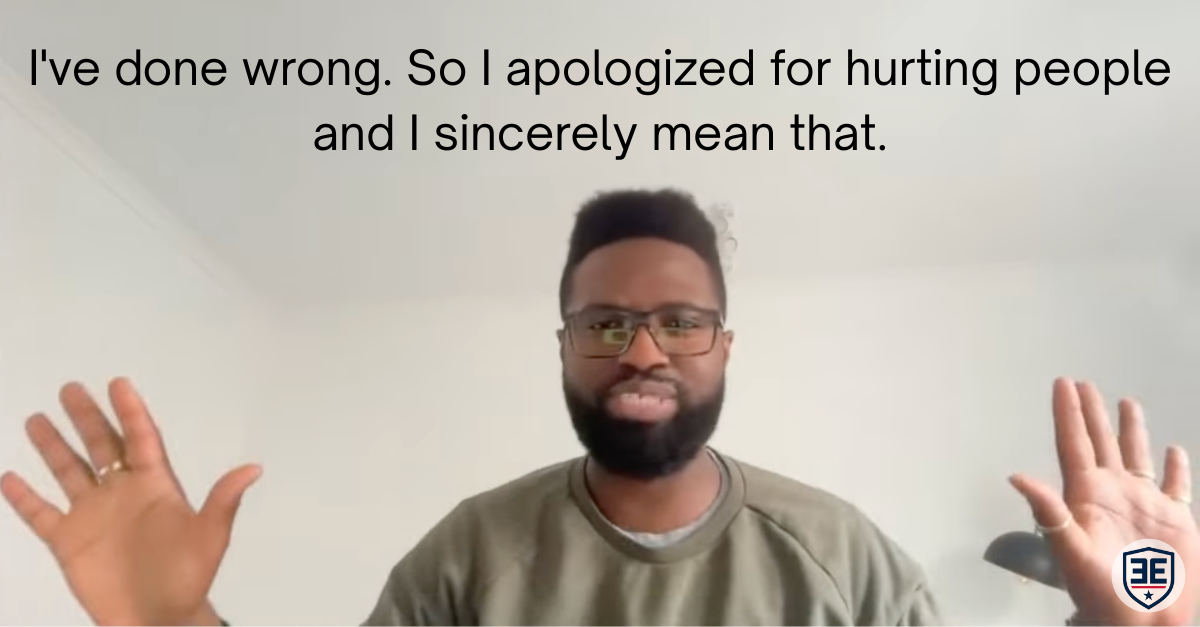
Emeka >> So, let me contextualize it and separate the two. So, do I think that it was okay to make a comment that people now have perceived as derogatory and not okay? Well, that wasn't in my intent, right? But I recognize that people perceive that in that manner. And I have a philosophy in life, right? If you throw a rock at my head, and it doesn't hurt me, and I don't even flinch and I just go about my day - that's that. If I throw a rock at your head and you say, "Ow, that really hurts me. What have you done?” I will apologize because though it might not hurt me, it hurt you, and I'm not okay with that. I'm not okay with hurting people. Now, when I posted that, I didn't realize it will hurt people. I didn't think that will hurt people, but people said I'm hurt. We're hurt. And so, I heard that. Now the doubling down that people are calling doubling down, it's not doubling down. I was defending the fact that, “hang on a second, guys. What is this? You launch an attack at people for being able to say something?” Like I said, if I went online and did half the things people have now done to my business, it would not be justified and okay the other way around. It would not at all, but somehow these very people get to tell me I can't say anything. I can't say these things, because it's not acceptable to them. They get to do even worse things to me in the name of inclusion for others. Well. I'm not human? I can't be included? I've seen so badly that I must not be included? How hypocritical. That's what I was defending - not doubling down on something that I've done wrong. So, at the right time, I apologized for hurting people. And I sincerely mean that.
Julie >> Have you have you seen an impact on your business already or is it just a threat?
Emeka >> I definitely think so. Definitely think so, Julie. It's sad. We serve over 1,200 participants, not just in Queensland, but we we serve participants in regional Australia, the aged population. And one of the reasons I'm actually down in Tasmania (and I've been here for twice as long as I would normally be) is because I have been accompanying some of my allied health folks who are out here in regional Australia to see the work they do in all of the regional areas - like remote regional which is quite long drives. And quite genuinely, one of the things I saw that made me realize that what we do is truly meaningful and impactful is how much the aged population just don't get the kind of service easily of physiotherapy and occupational therapy. We drive, fly over the sea, and drive hours to get to them, to provide 3 hours of service to them. How appreciative they were of it, how much they loved what we do, how much they they were thankful. I wish I could have recorded it, but one of the wives of the clients that we saw yesterday, she was just thanking us non-stop. Telling us non-stop how much she appreciates it. And the other one, her husband passed away after building this lovely home together. Just before they moved in, he passed away. It's just the saddest thing. But she couldn't stop thanking us. She said, "I never get anyone to come up to me. I'm so locked up in this house and doing nothing, but you guys have given me joy and a reason to get out again. The team put in place all these plans for her to get involved with community. They did research to find who they could get involved with: the drivers that could come and pick her up, who can come to their house, and clean it up. This is the work we do. That's the stuff that matters. I'm sorry that my words impact that ultimately for people to feel the need to attack my business. It's quite sad.
Julie >> Have any of your clients contacted you about what what you've said on LinkedIn?
Emeka >> Certainly. We've reached out. We've been reached out to a number of times now. Yesterday, we engaged in an investigation process and one of the founding results from that as an immediate action was that we placed out a communication to our clients informing them of what is taking place, some of the facts behind the matters, and we disseminated that across them to try and help them understand that you've not suddenly become unsafe because I said something that was not acceptable (which I admitted and agreed that it wasn't acceptable) but we had that conversation with the ones that have called. I've invited others to come and have a conversation with me as well as staff have said something. But I will tell you this: one of the things that has come out of yesterday was that one of our staff that identifies with the community, after the communication that was put out I believe that was one of the staff that had said they were no longer you know feeling safe or interested to remain in our organization. But after the communication we placed out yesterday, they've now asked to have a sit down conversation with myself. We can talk, because I asked for that. I said, "Come and educate me. Come and talk to me. Tell me how you feel about this because there are real issues here, and I'd like to support and help." I must say people genuinely were safe because I have over and over again proven that the care that I wish to receive tomorrow (when my spine degenerates and becomes even worse than what it is now) I would love to give that care today with the same level of dignity. If people didn't genuinely understand that, there is no way on earth a staff member who identifies with that community would have asked to sit with me and have a conversation, which is happening now next week.
Julie >> I think you. You kind of hit the nail on the head there. The video and then the comment you made may have left some of your clients feeling uneasy and unsafe. So I guess that answers the whole thing. I mean that is why those comments and that video have resulted in all of this coming out on social media. So I guess that’s the question: have you ever treated clients and staff (who have a different sexual preference to yourself) differently?
Emeka >> Julie, absolutely no. In no way. I mean I'm surprised you still feel the need to ask that question, but the reality is we've come to the crux of it, and I guess that is you know the reason why people are upset and that's te question. But Julie, you and I know that actions speak far louder than words. Right? They always have. That's not just a new thing in our generation, because actions have always spoken louder than words. If I had ever treated anybody with any level of indifference in the entire six years that I ran Neta Care for, do you not believe, Julie, that you would have heard about it by now, being a prominent reporter in this space? You absolutely would have. But I haven't. In fact, I'll tell you right now, the staff who's agreed to sit with me - who's asked, by the way, didn't get wasn't forced, wasn't coerced, who who asked, I made an invitation and they responded and said yes, absolutely they would like to - that staff member, I actually never really ever knew that they identified with anything. You know why I didn't know that? It never mattered. It never needed to come up in a professional environment. And I can tell you right now, that is one of the staff members that I have such fun times engaging with. We have a lot of jokes. A lot of laughs. We tease about many random things. But not for a second did I ever realize that. Did she ever feel the need to communicate that? Did she ever feel like there was a practice there of being unsafe with me that made her feel unsafe enough to highlight that up until now? And so words can be misconstrued and taken out of context. But when context is fully provided, I think people will see the real thing behind that and let actions continue to speak louder than words, which is why I'm sitting with her. And I'd like to hear her ‘cause I really, really, actually appreciate her. She's like one of my best staff. I think she's an amazing person. She does her work exceptionally well.
Julie >> You say actions are louder than words. Obviously words matter, which is why we're having this chat in the first place, because you have written things that people don't like. So I guess you know what you've written, or what you've been saying on LinkedIn, is appropriate for someone who's an NDIS director.
Emeka >> Appropriate as an NDIS director? No. I think it's very straightforward as far as that's concerned. As a director, you carry a lot of responsibility to lead people and care for people. I'll tell you one of the things I take the most seriously: I have maybe close to 500 staff and 1,200 clients and by goodness I take that seriously. 1,700 people whose lives (or maybe less but you know we're still nice people, so give us a chance) I take that seriously. That is 1,700 people whose lives I'm in some capacity responsible for. That's very serious to me. Very serious to me. Because I intricately understand the value of life. I intricately understand. I wasn't born in Australia. I was born in in Sierra Leone. I grew up in Nigeria. Sorry, I grew up in Sierra Leone, Nigeria, Ghana, and then Australia when I was 15. So I understand the value of life. I have seen some pretty crazy and intense things, which is why I am the biggest advocate. When I first started Neta Care, we lost so much money because I kept doing probono work, a lot of support coordination probono by the way, because nobody paid us for it, but people needed help. And so they couldn't tell me they needed help and I said, "No thanks.” Those are the facts. So I see your point of view absolutely, that it does affect the organization as a whole. Which is a fact. As much as people would like to say, “it's not a sincere apology.” I mean, what else do you want from me for crying out loud? I apologize, because I realize that it hurt people. Hurt then results in people like Brad and the likes of them going online and making very significant damaging content on our pages publicly so we can be cancelled, which is what they're doing whether they want to admit it or not. It is exactly what they're doing. It's live there. I don't have to even go delete it ‘cause I can't, even if I wanted to. Like people like to think that I do. They're just surprised that I can be so vocal about what is right and what is wrong about life in general and about protecting people and still be liked. So people are surprised when they see I have positive following. Well, yeah, because I advocate for humanity and I love humanity and I want us to all thrive. That's all I'm after. And so yeah, I haven't done any of the things that they've done in trying to bring an organization down the way they have, which I don't think is very nice, but it is what it is. I hope I've answered your question in all of that ramble. I apologize.
Julie >> In terms of the comments you made, you said that being gay was unnatural. Do you think that is still something that would upset clients, staff, the general public?
Emeka >> Julie, I feel as though I've answered that question already. I don't know if you’re asking it in a different angle to see whether my answers might change. If your particular question is did I think that it was okay to say that and if it was going to always hurt staff and clients, my answer has been no. I didn't think that, but it has resulted in that. Therefore, it is not okay, which means I must apologize because people are hurt. I hope that answers it succinctly.
Julie >> Yeah. I saw that there was a post put out by the board. Is that right?
Emeka >> That's right.
Julie >> Are you on the board as well? So you helped form that statement?
Emeka >> I was excluded from forming the statement. It's okay. Life happens. So the board formed the statement outside of myself.
Julie >> Okay. And will you stay on the board though?
Emeka >> Yep. As far as I'm aware at the moment. Yes.
Julie >> Okay. You haven't been asked to stand down from the board or anything?
Emeka >> No. Not at this point. But Julie, if I may ask the question there - in your view, being a reporter and what you've done and experience, why might that have to be the case?
Julie >> Because that's sometimes what happens if you brought the company into disrepute, I suppose.
Emeka >> Okay. That makes sense. Do you think if a person has done nothing but exceptional work, flawless character? Well, I'm not a flawless character. That'll just be strictly a lie.
Julie >> I'm just wondering whether you have been asked to step down?
Emeka >> No. I haven't. But I think it is worth understanding and noting as well, I think there is a perception that should absolutely be the case, but I think I defy that. Because if a person has done nothing but great things for a company, and they suddenly say something that is a mistake and it's not acceptable by the wider community that should tarnish everything that has been historically done - would that be fair?
Julie >> It's not for me to to answer that.
Emeka >> Sure. So I think let's put that out there as the fact, right?
Julie >> Okay. Do you want to add anything else?
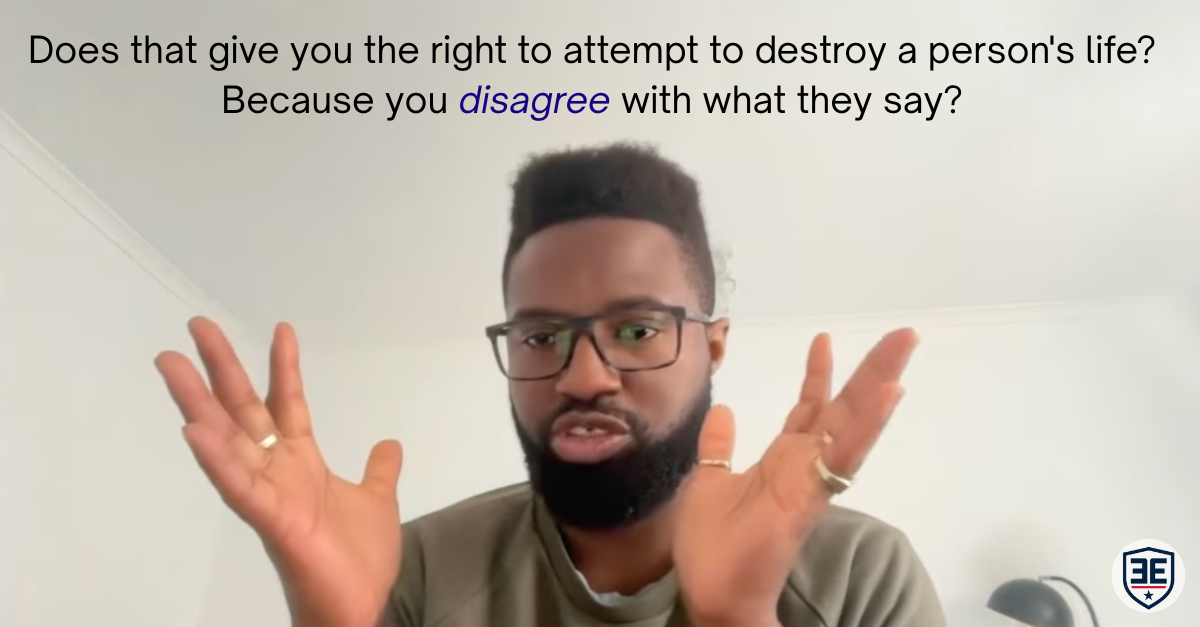
Emeka >> I think probably the biggest thing I wanted to highlight in all of this and what has become evidently clear for me is the hypocritical nature of of humans. You know, I've already apologized. I am sincere about the apology, whether people want to believe it or not. I do like to speak up for what is right, true, just, and I will get it wrong from time to time. I'll say things that are either not acceptable or not even true to my character or who I am or what I believe. But to see the adverse reaction of people, I get that people are upset, but does that give you the right to utterly attempt to destroy a person's life because you disagree with what they say? This is what the culture has rooted. And so, you may write. You may take this in whatever angle that you choose to take it. And you may write absolutely great things about me and the company and the fact that this is not okay or you may write absolutely bad things and say I should be condemned forever. But I think in all fairness, if we are going to be human, is it okay that some some things can be done and I can be accepted even though they have just as bad ramifications? I mean, when you're going around and you're publicizing, theorizing about the company, and who we are, and what we do, that is all based on facts, but you're corroding our online and social media platforms with information that is just inaccurate and that paints a picture of the company. You're not just affecting my life. That's the fact. Yeah, I have wife and kids and you're not just affecting my life. There are 1700 people that I'm responsible for. So if I've done something that makes you upset, talk to me about it. My character is not that flawed, but to go to the extreme to attempt a significant cancellation? To me, as a human being, that's so bad. Poor me. But there consequences in life to action, so be it, but to then go after the company and start doing all that stuff - that is not just hypocritical, it's not okay either. Like I said, if I attempt to do the same to somebody I disagree with because I fundamentally disagree with them because of my personal beliefs, would that be okay? I don't think it would be. Anyway, I think I can rest my case there.
Julie >> Okay. All right. Well, thanks for the chat and I'm sure I'll be speaking to you another time.
Emeka >> Oh, hopefully it'll be in better terms. I hope to grace your presence many more times. Take care. Bye.
Julie >> Bye.
Well, you've seen how it went. Wasn't what you expected, was it? Maybe controversial. Maybe not. I don't really know. But like I said, I decided to launch this as my first podcast for this platform because I thought it was quite interesting. The video and the articles and the commentary, all of it has gone quite viral and all over the internet. So, I thought I'd add a little bit more to that. Either way - this is first of many videos. So, if you read this, I ask that you subscribe, follow, or like. But if you do any one of those, you might see some very interesting things pop up from here. But, like I said before, what I'm doing here is about challenging the status quo, challenging things that need to be changed, while still doing my best to love and take care of humanity. So, that will always be the case, but you should follow for more and support what we do.
Additional Links:
Article by The Daily Telegraph (written by Julie Cross)
Make Your Voice Heard on sex-based rights for women and girls. Together, we can drive meaningful change. Support Sall Grover’s campaign and join thousands taking action. Each donation adds to the movement, inspires others, and enables legal action to take place.